The weaver counted his coins beside the last market stall.
Three coppers. He rolled them across his knuckles while the oil seller packed away his measures.
“Not enough,” the man said.
The weaver put his little flask back in his bag. On the way out of town he paused outside the alehouse. Cider and hot onions drifted through the open door. He opened his purse, looked at the three coins, and closed it again.
The blue cloth across his shoulders was still wrapped in sacking. No one had wanted it today. Tomorrow, at the harvest festival in his own village, he would try again. Someone would be married before the year was out. Someone would need a dress, a shirt, a length of good cloth for a table.
His left calf cramped as he reached the last houses. He stopped, leaned on his staff and pressed his thumb into the muscle. A tightness beneath his breastbone came whenever he hurried uphill. He waited for it to ease. The year had been long: market after market, village after village, his boots thinning at the toes. He was getting long in the tooth for this lark.
Sweat had gathered under his collar, though the air had a bite to it.
He set off again.
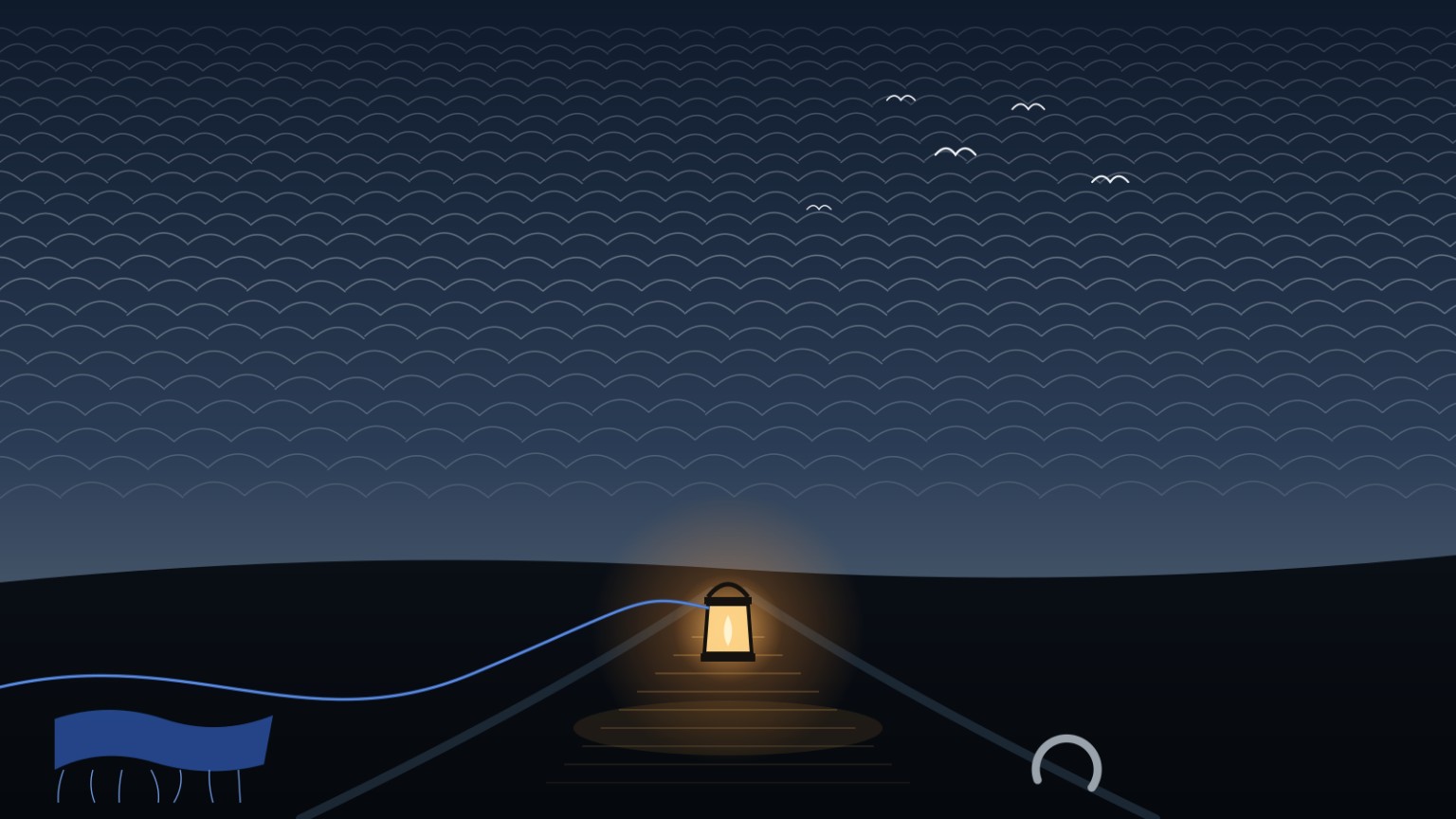
Above the fields, clouds lay in silver bands, scaled like a mackerel. His father had taught him the sailors’ saying: Mackerel skies and fishy scales mean tall ships will lose their sails. A warning of wind. Nothing more.
He watched the bands slide behind one another. For an instant the spaces between them seemed to open into something. By the time he tried to make it out, the light had changed.
A flock of gulls wheeled above the distant trees.
He stopped to watch them. There was a stream near the village, narrow and stony. No broad water for gulls. Their cries thinned over the fields as if they were circling a harbour hidden beyond the woods.
He knew that sound. For two years in his youth he had travelled with ships, not as a sailor but as a sail-weaver, carrying needles, waxed thread and patches of canvas to mend what the weather tore. He had seen gulls follow a vessel far beyond sight of land. He remembered their white wings wheeling over the wake, and a man’s voice lost in the wind.
He had been the one to cut the line.
The memory came and went: black water, a rope drawn hard across his palm, the captain shouting that the sail would take them all under. He had cut. The line sprang away. Afterward, no one spoke of the man who had been holding the other end. The ship made harbour. The weaver had come home with his hands intact.
He walked on.
The rutted lane climbed over two low hills before dipping into the wood. He knew every bend. Two deep wheel tracks ran between the trees, holding rainwater in their hollows. His left boot always sank at the same patch of clay; near the old ash, the right rut curved around a root. He could have walked the way home in darkness.
Gravel crunched beneath his boots. Spiders had strung their webs between the thorn branches. Dew silvered each strand. One caught his cheek; he drew it away with a fingertip and felt the silk cling there, finer than the thread in his bag. He put his hand to the blue cloth, reassured by its close, even weave.
The lane smelled of damp leaves and horse. Then a gust brought salt and rotting weed. He stopped, nose lifted. There was no sea beyond the hills.
A long, ragged bellow came from somewhere among the trees. A cow, perhaps. Or a stag in the October rut. The sound rolled dry through the branches and faded.
His lantern coughed.
“Hold on,” he said.
The flame fluttered. He tipped the lantern, listening to the last of the oil slide across its base.
Then he saw the cart tracks.
Fresh wheel marks crossed the old ones, their edges still sharp in the damp earth. Horse droppings lay dark in the rut; their smell rose when he stepped close. A copper coin glinted in the mud. He rubbed it clean against his sleeve and turned it between finger and thumb.
He slipped it into his pocket. If he caught up with the cart, he could give it back.
A few yards on, half sunk in a rut, lay a horseshoe, bright at the edges. He wiped it on his sleeve and hung it from his belt, points up, the way his father said kept the luck in.
“A lucky horseshoe,” he said. “Two in a hundred paces.”
A little farther on, a lantern lay beside the track, its iron hook bent sideways. The cart must be just ahead, somewhere beyond the bend. Perhaps the driver would give him a lift as far as the village.
“Third time,” he said.
He picked it up and gave it a shake. Oil shifted inside. He lit its wick from his own. The new flame caught at once, clear and steady. A smell like hot iron touched his nose. The handle was cold.
He pinched out his old flame and tucked his own lantern into his bag beside the cloth. He took the found lantern in his hand.
The new light reached ahead along the lane. Its flame leaned towards the bend, though the trees were still.
Sweat ran into his eye. He wiped it with his wrist.
He rubbed the cramp from his calf and followed. He pictured the house: his wife at the table, saving the last piece of bread; the children pretending to be asleep until they heard his step. The youngest had a loose tooth and had shown it to him three times that morning.
He pictured the child opening their mouth to show him again. He smiled.
A tiny sound came from inside the lantern.
Click. Click. Click.
Like a shuttle passing through a loom.
He stopped. The sound stopped.
He took another step.
Click. Click. Click.
The lane sank between high banks. Brambles caught at his sleeves. The lantern showed wet roots and stones, a few yards of path at a time. He watched the flame leaning ahead. The wheel ruts slipped out of sight at the edges of the light.
The gravel still crunched beneath his boots, but more softly now. Wet leaves covered the stones. He shifted the bag on his shoulder. The tightness beneath his breastbone returned, and he stopped to catch his breath.
The lantern pulled at his arm.
He changed hands. It swung low, heavy enough to tug at his shoulder. He shook it. Something shifted inside with a slow scrape.
“Too much oil,” he muttered.
A thread of blue trailed from his bag. He tucked it in.
A little farther on, the thread appeared again, stretched across the path. It ran from the sacking to the lantern’s air vent. Its end disappeared through the narrow opening.
The weaver tugged.
The lantern tugged back.
He let go. The thread drew tight, trembling against the stones.
His sleeves were wet to the elbow. A drop fell from his fingers onto the handle and was gone before it could run.
He pulled the cloth from his bag. One edge had begun to unravel. He pressed it between his palms, trying to hold the weave together. The cloth was damp. Grit had worked into the hem.
The flame brightened.
A strand slipped through his fingers and vanished into the lantern.
He dropped the cloth and tried to set down the lantern. His hand stayed closed around the handle. He prised his fingers loose, one by one.
The base touched the path.
The clicking ceased.
He stepped back.
The light shrank. The trees behind him disappeared, then the ground. He could no longer see the wheel ruts or his own boots.
He took another step away. The flame dwindled to a pinprick.
The weaver turned towards home. Somewhere beyond the trees, his children would be listening for him.
A blue thread tightened around his wrist.
The flame flared. The lane appeared again, but only ahead of him.
He picked up the lantern.
The thread slackened. The clicking began.
Click. Click. Click.
He walked on.
The cloth was coming apart inside his bag. A length slid over his shoulder and dragged behind him. He caught it, but more threads fed out, disappearing into the lantern’s vent.
He tried to remember the pattern: a blue field, a border, the small repeating shape at the edge.
The shuttle clicked.
The shape was gone.
The lane dipped. The lantern grew heavier. Gravel gave way beneath his boots: crunch, crunch, then a soft suck as the mud released each sole. The smell of damp earth turned salty. He shifted the bag on his shoulder.
A rut filled with black water. He stepped around it.
A few paces later, his boot sank to the ankle. When he pulled it free, water slapped against the leather.
His shirt clung to his back, cold now, and heavy.
The bellow came again. This time it carried water.
Water ran from his hair and down his wrists. He could not have said how much of it was his.
His boots slipped on stones slick with nothing he could see. The gulls cried overhead. Their wings crossed the lantern light, though he could not see them.
He looked for the old ash tree.
The lantern showed a strip of shining ground between two banks. No ash tree. No root. No wheel marks.
He turned, searching for the ruts behind him.
There were none.
The light fell across dark water. His footprints filled as he watched, each hollow turning black and smooth.
He knew this lane. He knew every bend.
There were no ruts now. No ash tree. No road home.
The lantern’s light trembled on the water ahead.
He thought of the youngest’s loose tooth. The child would be waiting to show him.
He tried to picture the child’s face.
The light pulled ahead, just beyond his reach. The thread drew taut.
“Home,” he said.
The word came out thin. A wash of water sounded somewhere in the dark. He had never imagined the dark so cold.
His hand went to his pocket, to the coin he had meant to give back.
The mud gave way beneath him.
At first light, his wife followed the lane. She found the blue cloth where the last wheel rut ended, its pattern picked apart. The lane was dry around it, but the cloth was soaked; when she lifted an edge, cold water ran from the weave. A single blue thread ran from it across the dry ground and ended at nothing.
Beside it lay the horseshoe, points down.
There was no sign of the weaver.
At breakfast, the youngest opened their mouth to show their mother. The tooth was gone. They searched the pillow and the bedclothes, but found no blood and no tooth.
Above the village, where no broad river ran, gulls circled and cried.