The Hidden tavern (rewrite)
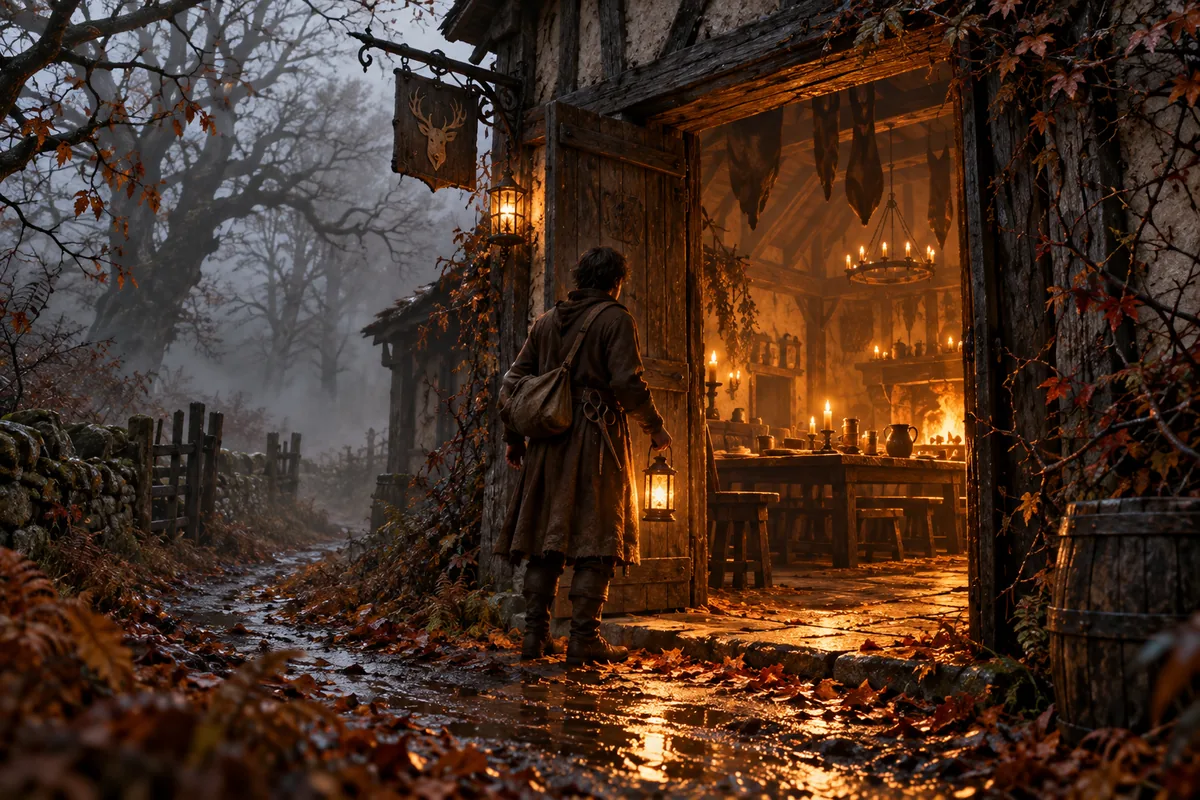
from a story https://medium.com/the-junction/the-hidden-tavern-27f508e43414 by me
THE TAVERN OF THE DEAD
The last market of October had been kind to him. He'd left the town of St. Aldric with a purse heavier than his pack — three dresses mended, a christening gown finished early, and, best of all, a wedding dress commissioned by a miller's daughter who'd wept with joy at the fitting and pressed an extra coin into his palm besides. He hummed as he walked, the coin purse knocking soft and constant against his hip, a small percussive comfort. A man could live a season on a day like that.
He'd heard talk in the market, over cider and cold meat, of a tavern further along the road — the sort that innkeepers spoke of with a strange mixture of envy and unease. Doing too well for a place so far from anywhere, someone had said. New silver on the table, new glass in the windows, and hardly a coach on that road to account for it. Another had laughed it off — envy talks, that's all, envy always finds a story — and poured more cider, and the tailor had thought no more of it. Gossip was the seasoning of every market day, and he had a wedding dress to be proud of and a purse to be careful with, and neither seemed cause for worry under an October sun.
By the time the sun failed him, he'd forgotten the warning entirely.
It was the edge of October, a dying autumn day. St. Aldric Church bells rang out their chimes on the late hour. Perhaps the next town wasn’t so far away? As the day came to a close, the last fingers of warmth left the woods. Dusk arrived, dusty and cool; mists swirled up from the ground, rising in tendrils.
The tailor emerged from the woods, stumbling and somewhat scratched by brambles and thorns. He hawked his trade from town to town, along timeless pathways. He’d started out in the late afternoon, hoping to get to the next village, but had gotten lost on the trail. The day had once been full of sunbeams and birdsong, ever welcoming, yet the scene changed as twilight tumbled. The woods were now long lost in the thick foggy sameness, a grey surround. Tree stumps littered the floor through the billowing fog.
The tailor spotted the faint lights of what he suspected was a far off village. They appeared like glowing eyes through the fog and swirled in and out of view. The tailor’s cheeks were salted with tears, having been whipped by the wind and burned by time and weather.
The path was difficult to follow, and his lantern spluttered and waved. The tailor shuffled and shivered through crisp leaves and broken branches. The lights inside a solid wooden frame blazed and he grabbed a cool iron thumb latch. Creaking like a coffin, the hinges rolled past each other. He swung open the door to the warmth and light of a tavern. He was safe.
Fear crisped from his forehead to his toes, electric, refreshing. Around the table, plates and glasses were found, as if a meal had been interrupted. A glazed ham had been half eaten, abandoned. The candles burned brightly. So many lit in a time of poverty meant a signal of some kind, or perhaps a celebration. He blew out many, keeping only a few lit so as to make it through the night. Where were the other customers?
He closed the door, which swung fast — and the terror hit him full in the stomach when he saw a single corpse swinging from the rafters, its lifeless legs wafting in an invisible wind. His breath locked. For a moment he could not move.
He forced himself to look away, scanning toward the bar for any sign of life, any explanation. As he did so, another corpse revealed itself, hanging just beyond the reach of the candlelight, its legs drifting gently as though stirred by a breath that did not exist.
The tailor turned, and there in front of him was the glinting smile of a dead man, pinned to the door. He’d been speared, gored, as if in mid-joke.
The tailor gave the sign of the cross and blew out the lantern. He hunted around in the shadows for a drink to calm his nerves. A bottle of whisky, that would do the trick. He found the slosh of a canteen full of oil. He refilled the lantern, and used his scissors to cut down the dead. There were no authorities out here in the muffled middle of nowhere. Here, the law was all too often ignored or even openly flaunted.
The inhabitants of the tavern had no documents or even any money. Some thief or highwayman had taken everything. The tailor turned to head for the stables out back. Kicking open the door, the dust climbed and stuck in his throat. A tall shadow stood in the corner — too still, too human in shape. For a heartbeat he thought it was a man waiting for him.
“Who goes there?” he cried.
A horse whinnied.
Only it remained. All the others had been taken. The surviving horse flinched in the moonless night, its shining dark coat lathered with sweat. That meant a rider had just tied it up — but whom? The tailor swung around to scan the corners. The shadows shifted with him, stretching and shrinking as if something had just stepped out of sight. But he found no one.
The tailor decided to give the dead a decent burial and get out in the morning. The murderer must have bolted when he saw him coming.
The blood swam its scent into every pore, into his nose and down his throat, as the tired tailor dragged and carried three poor souls to the garden. He would dig one grave only — there was no time or strength for more. Wild dogs and foxes and badgers and many more dangerous beasts, among them wolves and bears would creep out at this hour to explore nature’s larder. The tailor would have to work quickly as the night rose. Better those animals fed in the garden than there inside the tavern.
The tailor found a garden fork in the stable. He then rolled up his sleeves and relit the lantern. Its flickering light danced over the pile of bodies. The soil was cold and stubborn. Each shovel of earth felt heavier than the last.
A twig snapped somewhere behind him. He froze. The woods held their breath. A single pair of eyes blinked from the treeline — low, patient, watching.
He dug faster, breath ragged, sweat chilling on his neck. When the grave was finally covered, the eyes vanished into the undergrowth.
Then, the tailor crept back inside the shelter of the tavern and barred the windows and doors. He shivered as he poured a large tumbler of whisky. The tailor swigged it down, tears and all. The drink burnt the fear away. Having no barman to pay, the tailor was generous, and helped himself to a second dram.
He gathered some wood, lit a roaring fire and fell — sat in an armchair, holding the garden fork in one hand, and a third, very generous glass of whisky in the other. He was ready for anything and everything that might try to come through the door. A sleepless night awaited him.
Daylight soon came. A travelling priest knocked on the door, then pushed down on the iron latch. The priest took a step back, not daring to believe the vision that he found before him. A husk of a man in the chair, withered and dry, his life seemingly sucked away. His face was full of fear and sorrow, and the lines on his face were etched as if doused in acid. A filthy garden fork was lying on the floor, and an empty glass had rolled through the dust.
The priest eyeballed the whole tavern. Smoke smouldered in the fireplace. He saw one corpse first — hanging alone, gently swaying. Then, as he stepped further in, the second corpse revealed itself in the dimmer rafters, its legs drifting as if stirred by a breath that did not exist.
A cautious and penitent man, the priest stepped in and heaved the door shut. He wondered why it was so heavy, and that’s when he saw the smiling dead man pinned to the door. Was this real? It was real enough for him to flee.
He had found a tavern for the dead. Stumbling in fear, blood pumping in his temples, the priest turned and ran, and ran, and ran, until his very soul turned white with fear. The faint sound of his body, dropping dead into the hidden undergrowth wafted through the silent woods. His corpse was grabbed by the roots below, for the tavern was a monster that lived off the unfortunate visitors that came from far and wide.