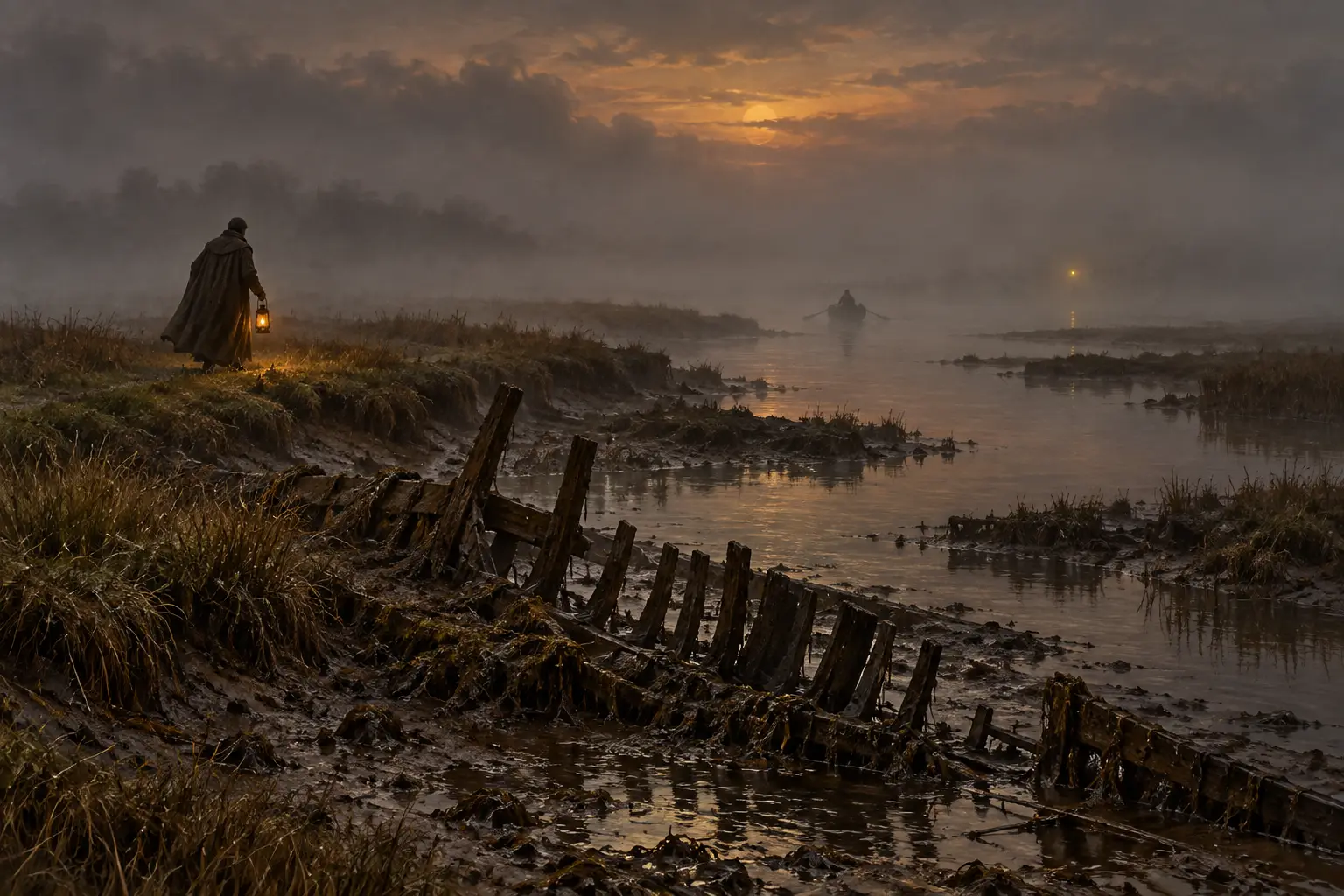
’Twould be hard to find a grimmer place than the Medway marshes, even today. Thick mud sucked at every misplaced step, and the air carried a smell fit to raise the very dead. In autumn, a chill swept up from the ground. Those abroad at dawn hoped the sun would burn their fears away; those caught at dusk watched the last silhouettes dissolve into a foggy ocean.
Such evenings seemed to swallow sound, light, even time.
Yet the folk who lived beside them feared the marsh for more than its mud and stench. They said that, after sunset, the fog went looking for travellers—and that those who heard their names whispered from the reeds were never seen again.
There were dangers enough with names and faces. Around the next bend might wait a highwayman, a smuggler, a fellow whose interest in your journey began and ended with your purse. The gangs took their cut. You paid—or took a cut yourself.
Smugglers had good reason to encourage tales of things moving in the marshes. A frightened witness stayed indoors. A haunted landing remained conveniently empty.
Many a traveller would splutter past the churchyards, with their stone pillows and their promises of “Here lies” and “late of this parish”, hoping not to find themselves tucked into that particular cold bed.
How gladly, then, they welcomed the lights of an inn.
Chapter 1 — Earth: Alice’s Story
Alice had been in her little shop for over thirty years. She would make potions and medicines, pastilles, tinctures, even just sloe gin for the evenings or peppermint cordial, using plants steeped in alcohol. She knew that if you rubbed some plants onto wounds they would heal faster, or the pain would go. As she sat in her kitchen, she wondered what would have happened to her a hundred or two hundred years ago, when she would probably have been accused of witchcraft and burnt at the stake.
She ordered everyone around. She played her part in the community, bringing the babes into the world and laying out the dead, and sometimes, tragically, both on the same day. She’d seen people come with last-chance looks in their eyes, with a nagging doubt or just a wee problem that needed an everyday solution, like constipation or charming warts.
She knew her customer was coming. He’d been before. His wife was sick again with the ague from the swamps and the marshes. There wasn’t much to be done. She could give something to lift the spirits, maybe some ginger, maybe a bit of bark from a willow to cool the fever, and she would add a little laudanum, perhaps, to help the patient.
Chapter 2 — Fire: The Landlord’s Story
“Fire!” said the officer, as he recounted his oft-spun story of Napoleonic adventure. Daniel, the drummer boy, sat and listened in Fort Clarence. He had heard it before, but he liked the telling, the officer’s hand raised, the pause before the guns went off.
For this was his memory of the army. He had come from Ireland as a young man, and the Medway had become his home. Amherst, Clarence, Pitt, all dotted around the towns, watching over the river and the dockyard. The granddaddy of them all, he guessed, was Rochester Castle, or perhaps Upnor Castle. There had always been someone to keep out, and someone ready to tell you how they’d done it.
Later, when he was out of the army, he found work in a small tavern where he could learn the trade.
Here he learnt to tend the ale, even brew his own beer, change the barrels and cook a meal. He met his future wife too. They married and sought out an inn of their own, settling into the Three Mariners in Lower Rainham around 1830.
They had children, and business was good. Travellers and locals frequented the place, men who worked on the water or in the fields, people who wanted a meal, a drink or a little company before going home.
His wife cooked, his daughter served, his son too. Daniel kept a cudgel behind the bar. Most days it stayed there, but there were drunkards enough, and now and then someone needed reminding whose house they were in.
The landlord was a jolly fellow, stout in body and hearty in manner, with a face you were glad to find at the end of a day’s travel. Lanterns hung from iron brackets outside. Through the bull’s-eye windowpanes came a blurred glimpse of firelight, moving shoulders and raised tankards.
Inside, folks warmed their toes in the inglenook while a ham glistened beside the fire. A warm meal awaited those who arrived in good time; the latecomer might settle for cheese and bread, and count himself fortunate.
Around the fireplaces of the inns of the world, many a tall tale was spun. Some were tall, and some were true, and after a third tankard the distinction seldom troubled anyone.
“They found his cart,” said the landlord. “His bundle was still beneath the seat.”
“Then he’d nothing worth stealing,” someone said.
The landlord laughed with the rest and reached for the carving knife.
Years later, when Daniel’s children were grown and his own hair was greying, there would be talk of still more forts. Palmerston’s follies, some would call them. They’d planned a new one out on the river at Darnet, not far from his inn.
That would bring in some trade, he thought.
Chapter 3 — Water: The Boatman’s Story
But the traveller had a name, and it was Thomas Vale. He had left his wife, Elin, sick in a cottage near Hoo, beyond the alder trees, across the Medway. Her fever rose each night and left her weaker by morning. The physician had sent him to an apothecary in Rainham for a bottle of medicine. If Thomas returned before dawn, Elin might live.
Thomas worked as a joiner at Chatham Dockyard. At home he sometimes made a cupboard or mended a chair, work he could do with Elin nearby. Today he had left his tools where they lay.
Before fastening his cloak, Thomas felt beneath his shirt for the little locket. Inside lay a curl of hair, finer than either his or Elin’s. She had cut it herself. Neither of them opened it now.
The physician called her illness an ague. Thomas knew only the shaking, the burning skin, and how small her hand had felt in his that morning.
He held the locket through the cloth.
He had come home too late once before.
Daniel nodded towards a man sitting by the fire.
“Will. This gentleman wants to get across to Hoo.”
The boatman looked up, then towards the window. He put on his coat and went outside to see what the fog and the water were doing.
When Will came back into the Three Mariners, the damp was still on his coat. He stood by the fire and warmed his hands.
“We’ll have to wait a bit. The tide’s still going out.”
Thomas looked down at his bag. He had the medicine now, but his wife was over near Hoo, sick again with the ague, and he could do nothing for her sitting here.
“How long?”
“Half an hour, perhaps.”
Daniel offered him another ale, but he had hardly finished the first. From the kitchen came the smell of something cooking. His daughter carried a plate past him while his son brought in more wood. They all had things to do. Thomas could only wait.
“My wife’s ill,” he said. “I’ve been to get something for the fever.”
Will nodded.
“We’ll go when we can.”
When at last he reached for his coat, Thomas was already standing. Daniel gave them a lantern and watched them leave.
The fog had crept up from the river. It lay along the road and hid the houses, the hedges, even the ground a little way ahead. Thomas remembered the warmth of the room almost as soon as he was outside. Here there was the cold, the damp and that strange silence.
He kept close to Will as they turned down towards Bloors Wharf. He could hear their boots in the mud. Once he heard water somewhere ahead, though he could see nothing of it.
Down at the wharf the day’s business was slowly drifting away. Blinkered horses pulled their carts up the lane, taking the harvest to market. The higgler’s oxen followed, pulling a cart with the eggs packed carefully beneath a cloth.
The fog seemed to bubble out of the ground. People swore the veil was getting thinner by the day, and the fog thicker.
A labourer was waiting beside the boat, his empty sack folded under his arm. He knew Will, and nodded to Thomas when he heard they were going to the same shore.
The tide was rising as they clambered into the boat: the labourer first, then Thomas with his bag, and Will last, pushing them clear with an oar. His pipe smoke drifted between them before disappearing into the whiteness.
“Take the tiller,” he told the labourer. “Easy with it. I’ll tell you when.”
Will had learnt the river over years, first beside an older boatman, then on his own. He knew where the mud lay beneath the water, where a loaded boat needed room, and when it was better to wait. Men who argued with him about the tide generally stayed ashore.
He picked his way through the channels, keeping clear of the mudbanks and the ribs of an old wreck. Thomas caught a last glimpse of the moon reflecting on the ripples. Then that went too.
The boat began to pull sideways. Will leaned into the oars, his boots braced, drawing her round into the next channel. The labourer held the tiller steady. Neither spoke. There was only the creak of wood and the swish of the blades.
The cold swept in with the tide, seemingly freezing them all into statues. Thomas tucked his hands beneath his arms. Will puffed on his pipe, but it had gone out.
He rested on the oars for a moment. Here he expected the current to take them. He watched the water beside the boat, then dipped a blade into it.
“What is it?” Thomas asked.
“Nothing,” Will said, and began to pull again.
The labourer looked at him but said nothing.
Thomas thought of Elin lying at home, sometimes burning hot, sometimes shaking so much he could hardly hold her. Perhaps Alice’s medicine would help. Perhaps by morning the fever would have cooled and she would ask for something to eat.
He held the bag a little closer. Will rowed on.
Air — Thomas’s Story
They crossed in silence. Thomas listened to the dip of the blades until he realised he could no longer hear the water against the hull.
“Thomas.”
He turned. It had sounded like Elin, speaking quite softly, just behind his shoulder.
The labourer looked past him into the fog. His hand tightened on the tiller.
Will lifted the oars clear. A little water ran from the blades, but none of them heard it fall.
“Sit still,” he said.
Thomas was still seated, the bag between his knees. The labourer could see his hand resting on it.
Then the fog passed between them.
The labourer reached for Thomas’s sleeve. His fingers closed on nothing.
The boat had not rocked. There had been no splash.
When Will could see the stern again, the labourer was sitting alone. Thomas’s bag lay at his feet.
The labourer called Thomas’s name while Will searched the water with his pole. He searched beneath the seats and along the bottom boards. Thomas’s bag was still there. Inside it he found the bottle, still stoppered. The leather was cold enough to sting his fingers.
They reached the far bank with the medicine and Thomas’s bag. The labourer knew the cottage beyond the alder trees and went with Will to its door.
No one remembered seeing Thomas arrive.
Afterwards, the labourer told anyone who asked that Will had done what he could. He had been there. He had seen it. But when they asked what he had seen, he struggled to say.
People still needed to cross. Some went with Will; others found reasons to wait for another boat. One man who had known him twenty years asked who else would be aboard. Will looked past him towards the water.
Chapter 4 — Water: Elin’s Story
She received the boatman in bed, her face white against the pillow. He set the bottle and bag beside her and told her what little he knew. As he spoke, water ticked steadily from the bag onto the floor, though the leather was dry to the touch.
At the mention of the fog, she looked towards the open door. Beyond it, the mist had gathered in the yard. It lay between the alder trees, and for a moment she thought she heard Thomas calling her name.
Elin did not die that night.
The boatman had brought her the medicine, and in time the fever passed. She grew strong enough to rise, to tend the fire, to open the door and look beyond the alder trees. But Thomas did not come home.
She waited for him, and for the baby they had lost. Sometimes she thought she heard them when the fog came creeping up from the marshes, a voice she knew, a small cry. She would stand listening until the cold brought her back inside.
There were years still to live. Bread to cut, washing to dry, people who came and sat awhile. Sometimes she laughed, then wished she could tell Thomas what had been so funny.
Her hair softened into silver. Still she waited, bound by mourning and the weight of love. Love that had sent him across the water to find her medicine. Love that saved her, love that cost her.
And love that finally freed her, the day her soft silver hair finally swept into the billowing fog.
The Marsh Aftermath
For years after Thomas vanished, the alder trees stood heavy with fog even on clear nights. The villagers barred their shutters before sunset. Children were kept from the water’s edge. Some said the bag the boatman brought home still dripped marsh water, though the leather was dry to the touch.
Some swore they heard knocking from the reeds.
Others said they heard names, spoken in the tone of someone standing very close behind them.
Those who saw shapes in the mist said they looked like men walking home after long journeys—heads bowed, shoulders slumped—but their footprints never led towards the marsh.
Only out of it.
And now, when the fog rises at dusk, the villagers say:
“Close the door. The marsh is remembering.”