Please, sir, we want some more
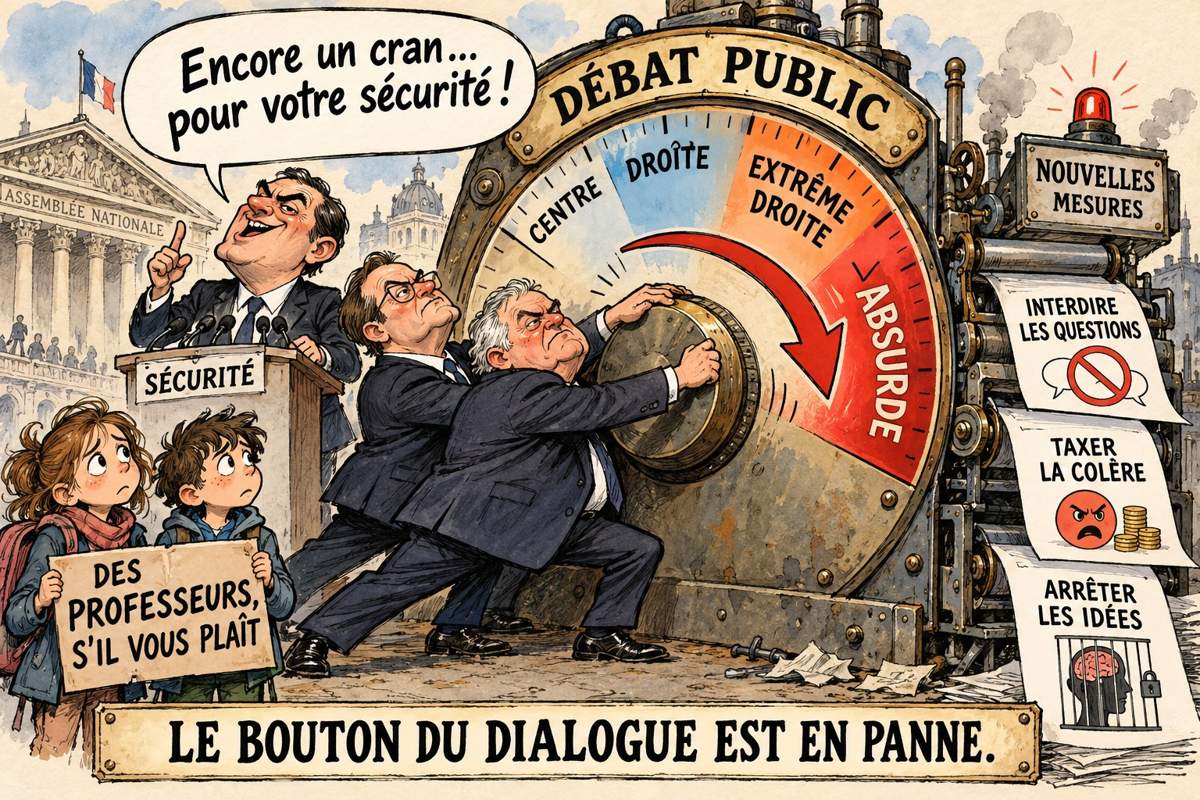
I am fed up with the sterile debate about security that France has been having for twenty years. From Sarkozy’s Kärcher onwards, we have heard promises to clean up neighbourhoods, restore order and get tough. Yet the same problems persist, while the services that might help resolve them are stretched thin. We get the posture of authority without the patient work of government.
As another presidential election approaches, the competition seems increasingly to be about who can sound the most extreme. Immigration becomes the explanation for every failure. Politicians warn that the sky is about to fall, then offer another crackdown as though it were a programme for the country.
We have travelled so far to the right that the solidarity needed to hold France together is being put at risk. And now, faced with protesting schoolchildren, our political debate centres on punishment while their demands struggle to be heard.
There is something painfully Dickensian about it. In Oliver Twist, a hungry orphan in a workhouse asks for another helping of gruel, and the authorities treat his request as an outrage. Our young people are asking for more: more teachers, better conditions, an education that gives them a future. After serving up a meagre dish, politicians seem astonished that the children are still hungry.
The imbalance in coverage is measurable. Acrimed examined France 2’s lunchtime and evening news between 28 September and 1 October 2026. Across eleven reports, totalling 24 minutes and 53 seconds, it recorded:
| Subject | Airtime | Approximate share |
|---|---|---|
| Violence, fires and confrontations | 19 min 26 sec | 78% |
| Government accusations against LFI | 2 min 58 sec | 12% |
| Pupils’ demands | 1 min 56 sec | 8% |
| Organisation of the movement | 33 sec | 2% |
Within the coverage of violence, just 47 seconds addressed possible excessive police force. This is one organisation’s analysis of a specific sample, rather than a measure of all French media. Nevertheless, the imbalance deserves scrutiny: viewers were shown much more of the destruction than of the reasons for the protests. [1]
We must also be careful about who gets blamed. Le Monde reported that those responsible for the fire at Nantes’s Nelson-Mandela lycée remained unidentified. Pupils suspected outsiders. Separately, police said that 22 of 24 people arrested over fire-related incidents across Nantes were minors attending schools in the metropolitan area. Those arrests did not establish who had burned Nelson-Mandela. [2]
A pupil can commit criminal damage. An outsider to one school can attend another. But being young, being arrested or standing near a burning bin does not establish responsibility for setting it alight. We need evidence before we turn an entire generation into the accused.
None of this excuses arson, intimidation or attacks on people. Those responsible should answer for their actions. But condemning violence does not require us to ignore the demands of peaceful demonstrators or abandon scrutiny of police conduct. Images of force used against young people should prompt serious questions about necessity, proportionality and accountability.
Instead, the ministers responsible for justice, education and the interior seem caught in a fairground contest: who can knock down the most targets with the toughest announcement? Who can propose the harshest measure? Governing becomes a performance of severity.
Meanwhile, politicians such as Marine Le Pen make migrants the scapegoats for failing public services. That rhetoric allows us to avoid discussing political choices, staffing, funding and the people—including immigrants—whose work keeps those services functioning.
The presidential field is crowded, but substantive projects seem much scarcer. Too many candidates resemble Iznogoud: their overriding ambition is to become “caliph instead of the caliph”. Getting into power takes precedence over explaining what they would do with it.
A democracy also needs media that make room for disagreement and investigate the causes beneath the spectacle. When political debate becomes “agree with me or you are the enemy”, we lose the ability to think together. We seem to be adapting the old Ford maxim: you may have any opinion you like, provided it is mine.
France cannot be held together by sorting its people into supporters and enemies. Nor can public broadcasting fulfil its purpose if political pressure narrows the range of voices it can carry.
We need calm, respect and policies with substance. We need to listen to young people, protect peaceful protest, investigate violence fairly and rebuild the services on which everyday security depends.
After twenty years of escalating rhetoric, I want leaders who understand that authority carries obligations. Asking for a decent education should not make a child a threat. Asking for more should make those in power consider what they have failed to provide.
Richard Jenkins
Sources
[1] Acrimed, Jérémie Younes, 2 October 2026: Au JT de France 2 : poubelles brûlées partout, revendications des lycéens nulle part.
[2] Le Monde, 2 October 2026: Mobilisation lycéenne : à Nantes, les élèves du lycée Nelson-Mandela, incendié, ont le « sentiment d’être décrédibilisés ».